Ostium vs Lighter Arbitrage: Understanding Rollover Fees vs Standard Funding Rates
Master the differences between Ostium's rollover fees and Lighter's standard funding rates to identify profitable arbitrage opportunities in crypto and RWA perpetual futures trading.
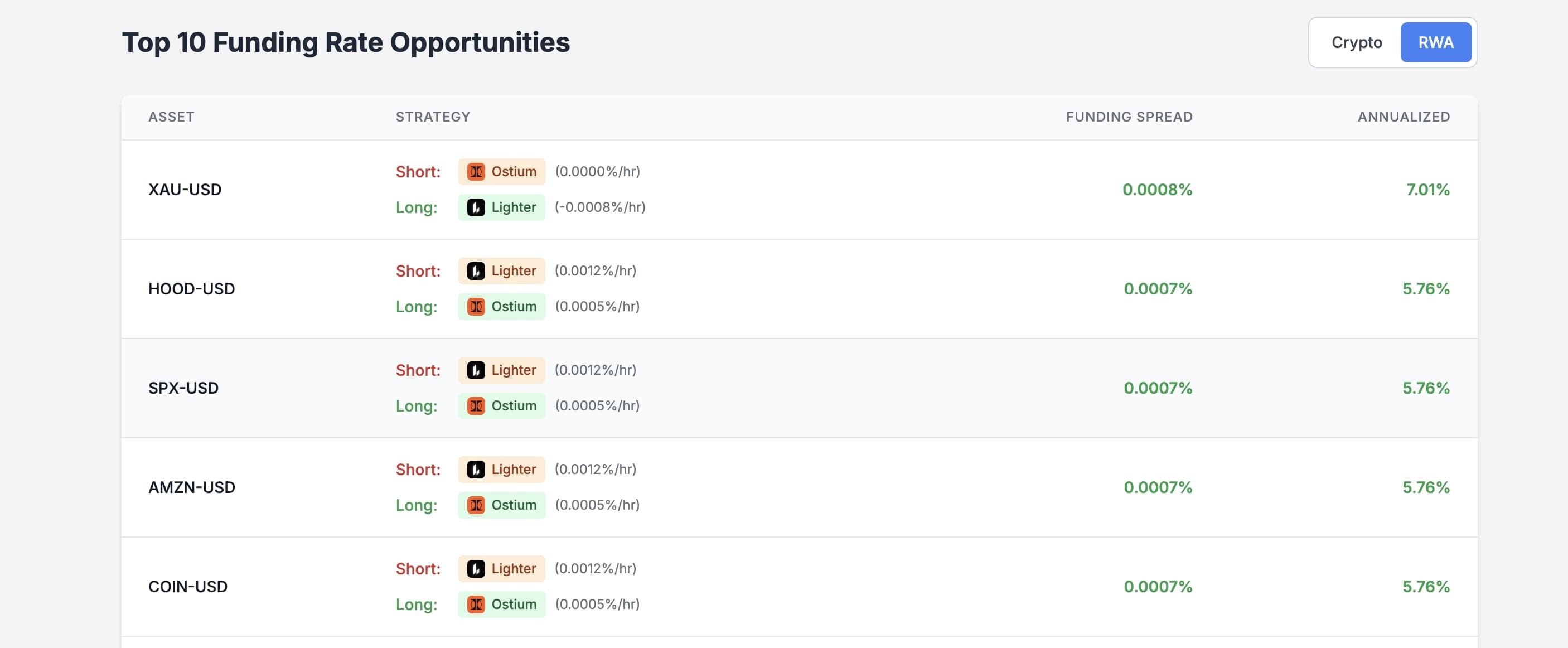
Perpetual futures trading has evolved beyond pure crypto assets, with platforms like Ostium bringing real-world assets (RWAs) like stocks, forex, and commodities to DeFi. But not all funding mechanisms are created equal—understanding the difference between Ostium's rollover fees and Lighter's standard funding rates is critical for spotting arbitrage opportunities and managing costs.
This guide breaks down both models, compares their mechanics, and shows you how to trade smart across crypto and RWA perpetuals. Whether you're chasing funding rate spreads or hedging TradFi exposure on-chain, this is your playbook.
Ostium Rollover Fees: TradFi Economics in DeFi
Ostium is a decentralized perpetual futures platform focused on real-world assets (RWAs) like forex, commodities, indices, and stocks, in addition to crypto. For non-crypto pairs, it uses rollover fees instead of traditional funding rates to handle ongoing holding costs. These fees are designed to reflect real-world "carry costs" associated with the underlying assets, such as interest rate differentials (e.g., in forex), storage costs (e.g., for commodities), or dividend impacts (e.g., for stocks).
Key Characteristics of Ostium Rollover Fees
Application: Only on non-crypto perpetual positions (crypto pairs use standard funding rates instead).
Calculation: Compounded per block (continuously on-chain) and is settled when the user closes his position. It's based on underlying market swap, funding, or carry costs, often optimized for volatility—typically ranging from 1-3% annualized on FX pairs, which is lower than many industry standards.
Direction and Purpose: Unidirectional fee paid by position holders (long or short) to the protocol's liquidity pool (OLP). It's essentially an "overnight cost" to simulate traditional finance rollover mechanics in DeFi, ensuring the protocol captures real-world economics without relying on dynamic user-to-user payments.
Benefits:
- More transparent and predictable than volatile funding rates, as it's tied to stable real-world factors rather than market sentiment
- 100% of these fees go to liquidity providers, incentivizing liquidity
- Enables high leverage (up to 200x) on RWAs while keeping costs aligned with traditional markets
Drawbacks:
- Can add up for long-term holds, acting as a holding cost that indirectly reflects things like dividends or financing rates
- Always a cost to holders—you can't earn positive funding like on standard perps
Real-World Example
Say you're long EUR/USD at 10x leverage on Ostium with $10,000 notional. With a 4% annualized rollover fee:
- Daily cost: $10,000 × 4% ÷ 365 = ~$1.10/day
- Hourly cost: ~$0.046/hour
This mirrors forex swap rates, but settled on-chain continuously—ideal for short-term trades, less so for multi-week holds.
Lighter Standard Funding Rate: The Crypto Perp Standard
Lighter is another DeFi perpetual futures DEX, primarily focused on crypto assets, with zero maker/taker trading fees to attract volume. It uses a standard funding rate mechanism, which is common in crypto perpetuals to keep the contract price anchored to the spot (index) price without expiration.
Key Characteristics of Lighter Standard Funding Rate
Application: Applied to all perpetual positions, typically crypto-based pairs.
Calculation: Determined by the premium (difference between the mark price of the perp and the index/spot price). It's recalculated periodically (e.g., every hour or 8 hours, depending on the protocol) and can fluctuate based on market conditions.
Direction and Purpose: Bidirectional payments exchanged directly between long and short position holders. If the funding rate is positive (perp price > spot), longs pay shorts; if negative, shorts pay longs. This balances market skew and prevents the perp price from drifting too far from the underlying asset.
Benefits:
- Can be profitable for traders on the receiving side (e.g., earning funding by holding against the crowd)
- Dynamic and reflects real-time sentiment, helping maintain price efficiency without protocol intervention
- Zero trading fees on Lighter make it ideal for high-volume farming
Drawbacks:
- Highly volatile and unpredictable—rates can spike during market imbalances, leading to unexpected costs for one side
- Not tied to real-world carry costs, so it's more sentiment-driven
- Requires active monitoring to avoid paying 0.05%+ per period in extreme conditions
Real-World Example
You're short ETH-USD on Lighter at $3,000 with $10,000 notional. The funding rate is +0.01% (8-hour):
- Per funding period: $10,000 × 0.01% = $1 (you receive this from longs)
- Annualized: 0.01% × 3 × 365 = ~10.95% APY
If sentiment flips negative (-0.02%), you'd pay instead—volatility cuts both ways.
Key Differences: Ostium vs Lighter
| Aspect | Ostium Rollover Fees | Lighter Standard Funding Rate |
|---|---|---|
| Primary Use Case | Non-crypto RWAs (forex, commodities, stocks) | Crypto perpetuals |
| Mechanism | Unidirectional fee paid to liquidity pool | Bidirectional payments between users |
| Basis | Real-world carry costs (e.g., interest, storage) | Market premium (perp vs. spot price deviation) |
| Frequency | Compounded per block, settled end-of-epoch | Periodic (e.g., hourly or 8-hourly) |
| Predictability | More stable, tied to underlying economics | Volatile, driven by market sentiment |
| Direction | Always a cost to holders (long/short) | Can be positive/negative; one side pays the other |
| Platform Revenue | 100% to liquidity providers | Typically net-zero for platform; balances users |
| Example Impact | 1-3% annualized on FX, reflecting overnight costs | Can range from -0.03% to +0.02% per period, allowing arbitrage |
Arbitrage Strategies Between Ostium and Lighter
Strategy 1: Cross-Platform Funding Spread (Crypto Pairs)
Setup: Ostium lists BTC-USD with standard funding (+0.015% hourly), Lighter shows -0.005%.
- Action: Long BTC on Lighter (earn funding), short on Ostium (pay less or earn more)
- Profit: 0.02% hourly spread × 24 = 0.48% daily, ~175% annualized
- Risk: Price divergence between platforms—use limit orders to enter at parity
Strategy 2: RWA Cost Arbitrage (vs TradFi)
Setup: Ostium's EUR/USD rollover is 4% annualized, while Interactive Brokers charges 6% swap.
- Action: Long EUR/USD on Ostium instead of IBKR for carry trades
- Profit: 2% annualized savings + DeFi transparency
- Risk: Counterparty risk (Ostium's OLP solvency vs IBKR regulation)
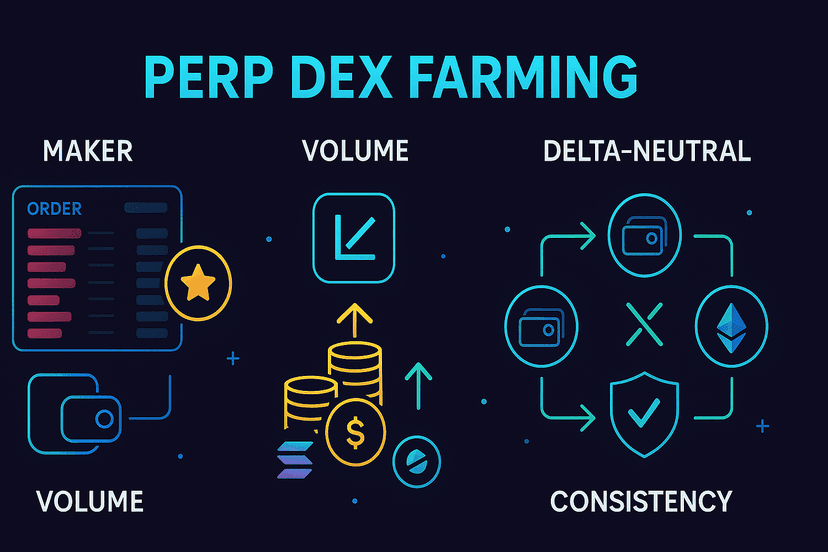
Strategy 3: Delta-Neutral Farming
Setup: Lighter offers 2x points on BTC volume; Ostium has lower fees+points.
- Action: Long $10K BTC on Lighter (farm points + earn negative funding), hedge with equal short on Ostium (points as well!)
- Profit: Airdrop value + net funding income, minus rollover costs
- Risk: Basis risk if one platform's price lags; use tight stops
Risk Management Tips
- Monitor Funding Volatility: Use alerts (e.g., our arbitrage dashboard) to track rate spikes—exit if Lighter funding exceeds 0.05% per period.
- Hedge Delta: Keep positions equal-weighted across platforms; rebalance daily to avoid directional exposure.
- Factor Rollover into Holding Time: Ostium's compounding fees favor sub-24h trades (continuous charge); Lighter's 8h cycles suit swing trading.
- Liquidity Check: Test with $100 orders first—low OI on exotic RWAs can cause 2-5% slippage.
Platform Picks: Where to Trade
Ostium
Best for RWA exposure with predictable costs and points program on top. Trade EUR/USD, gold (XAUUSD), or stock indices like SPX at up to 200x leverage. Rollover fees are transparent and LP-friendly—ideal for arbitrageurs hedging TradFi positions. New markets weekly.
Lighter
Zero-fee crypto perps with aggressive points programs. Perfect for funding rate farming—pair with Ostium to lock spreads. Season 2 offers 250K points weekly; TVL at $816M. Supports API trading for automated arbs.
Final Thoughts
Ostium's rollover fees mimic traditional finance's holding costs for synthetic RWAs, making them a protocol-collected expense that's predictable but always present. Lighter's funding rate is a crypto-standard tool for price anchoring, where traders can earn or pay based on market dynamics, offering potential income but with more volatility.
Choose Ostium for: Stable RWA exposure, long-term hedges, or TradFi cost arbitrage with points program. Choose Lighter for: Crypto funding rate farming, high-volume point chasing, or delta-neutral pairs.
Ostium uses funding rates for its crypto pairs, so the rollover is specifically for bridging DeFi to real-world assets. If you're trading on either, consider your asset type and holding horizon—rollover suits stable RWA exposure, while funding favors short-term crypto plays.
Track live opportunities on our Arbitrage Dashboard, and stay tuned to our guides for more DeFi strategies.
Disclaimer: Perpetual futures are high-risk. Trade only what you can afford to lose. This is educational content, not financial advice. Always DYOR.